10 Best A C Vacuum Pumps for 2026 - Expert Reviews and HVAC Buying Guide
Disclosure: We may earn a commission when you buy through links on this page, at no extra cost to you. As an Amazon Associate I earn from qualifying purchases. Learn more

Whether you are a seasoned HVAC technician, an ambitious DIY homeowner installing a ductless mini-split system, or a car enthusiast repairing an automotive air conditioner, having the right equipment makes all the difference. Pulling a deep vacuum is not just a procedural step; it is the most critical stage in air conditioning and refrigeration maintenance. Operating an air conditioner with trapped moisture or non-condensable air inside the lines leads to hydrochloric and hydrofluoric acid formation, sludge buildup, elevated head pressures, and premature compressor failure. In our comprehensive 2026 guide, we analyze the 10 top-performing models on the market from brands like VIVOHOME, Robinair, and Kozyvacu to help you choose the ideal system for your garage, workshop, or service business.
Finding the right balance between flow rate, ultimate vacuum depth, motor durability, and accessory compatibility can be challenging with so many options available across $56–$272. To assist you in making an informed investment, we have broken down the technical specifications, real-world evacuation capabilities, and long-term reliability of each model. If you are also setting up your home workshop or utility room, be sure to explore our complete Vacuums & Floor Care resource hub for expert equipment comparisons and maintenance advice.




Best A C Vacuum Pumps Buying Guide
Selecting the ideal vacuum pump requires an understanding of how mechanical evacuation works and what specific demands your cooling systems will place on the tool. A vacuum pump functions by mechanically expanding the volume of its pumping chamber, capturing air molecules and moisture vapor, and discharging them out through the exhaust port. Below are the primary technical criteria you should evaluate before choosing your next unit.
1. Pumping Speed and CFM Ratings: Choosing the Right Flow Rate
Cubic Feet per Minute (CFM) measures the volume of air a vacuum pump can displace under unrestricted conditions. A common misconception among DIY mechanics and homeowners is that a higher CFM pump will always achieve a deeper vacuum. In reality, CFM determines evacuation speed rather than ultimate vacuum depth. A higher flow rate allows you to purge larger internal line volumes faster, reducing the time required to drop the system down to boiling pressure.
For standard passenger vehicle air conditioning systems, small residential window units, and refrigerator repairs, a pump rated between 3.0 CFM and 3.5 CFM, such as the XtremepowerUS 3CFM 1/4HP Vacuum Pump HVAC R134a or the Single-Stage HVAC Vacuum Pump, 3.5CFM, provides more than enough volume displacement. These compact pumps evacuate automotive circuits in 15 to 30 minutes without overloading standard household electrical circuits.
For whole-home central heat pumps, commercial reach-in coolers, or multi-zone mini-split installations with line sets exceeding 25 feet, stepping up to a 4.0 CFM to 5.0 CFM model is strongly recommended. Options like the 4.5CFM 1/3HP Vacuum Pump for HVAC Systems and the Robinair 15500 VacuMaster Economy Vacuum Pump cut total evacuation time significantly, helping ensure that moisture does not freeze inside the lines during rapid pressure drops.
2. Single-Stage vs. Two-Stage Vacuum Mechanics and Ultimate Micron Levels
Vacuum depth is measured in microns (one thousandth of a millimeter of mercury) or Pascals (Pa). Standard atmospheric pressure at sea level is approximately 760,000 microns. To vaporize ambient moisture at normal room temperatures (70 degrees Fahrenheit) and extract it from an air conditioning loop, the system pressure must drop below 500 microns. This is where the structural design of the pump rotary vanes becomes essential.
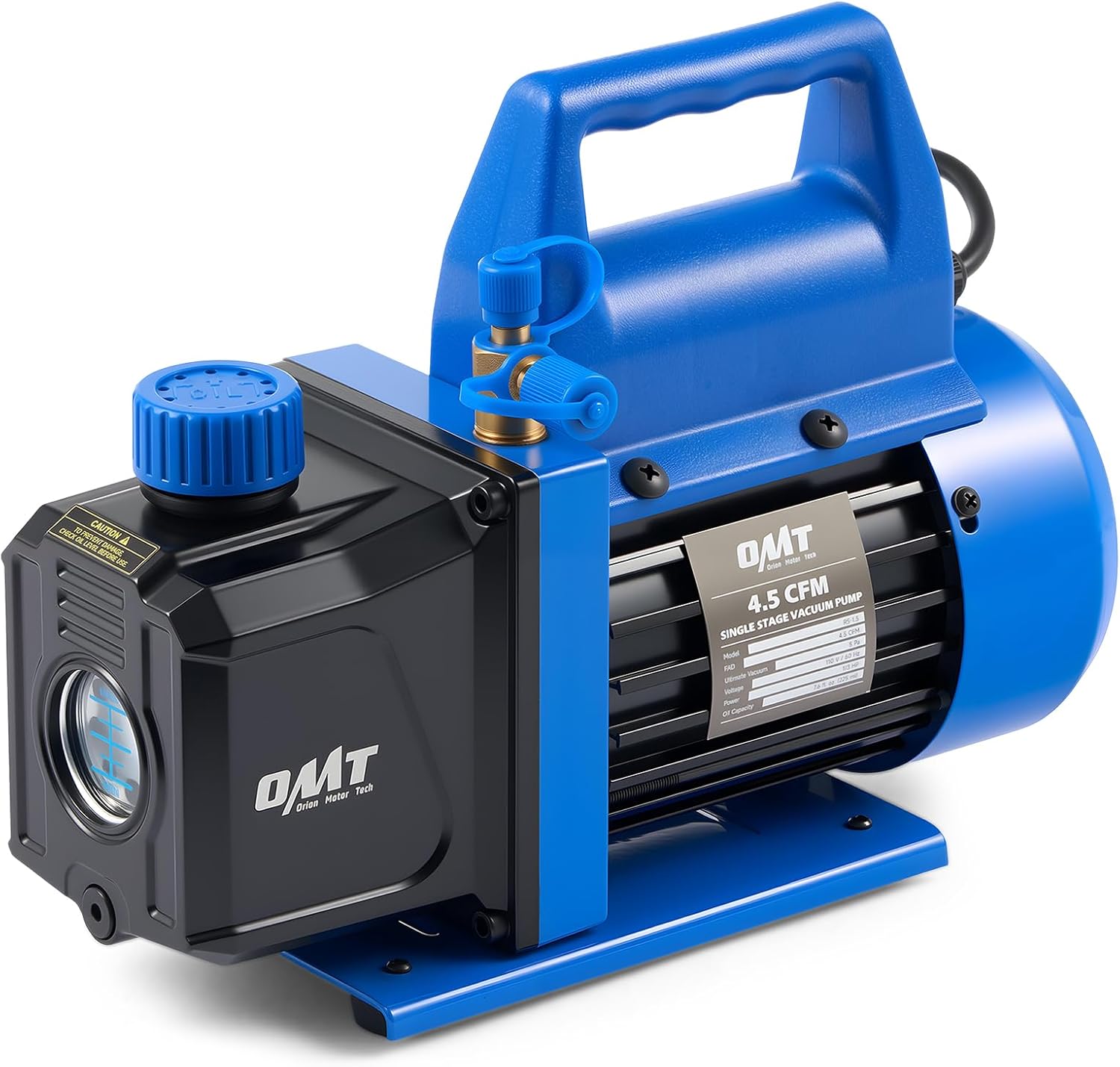
Single-stage vacuum pumps utilize a single rotor and vane set to compress and exhaust air. Quality single-stage units, such as the VIVOHOME 110V 1/4 HP 3.5 CFM Single Stage HVAC and OMT 4.5 CFM Single Stage Vacuum Pump for R134a, typically achieve ultimate vacuum levels down to 5 Pa (around 37.5 to 50 microns under factory test conditions). These are exceptionally reliable for automotive servicing, hobbyist epoxy resin degassing, and standard appliance repair.
Two-stage vacuum pumps, such as the Robinair 15500 VacuMaster Economy Vacuum Pump, connect two rotary chambers in series. The exhaust of the first stage feeds directly into the intake of the second stage, allowing the unit to reach an ultra-deep factory rating of 35 microns. This two-stage design provides higher vacuum stability and faster moisture boiling, making it the industry standard for professional HVAC installations and multi-ton residential systems.
3. Motor Construction, Horsepower, and Thermal Dissipation
The electric motor is the heart of your vacuum pump. Most portable pumps use copper-wound electric motors ranging from 1/4 HP (approximately 180 watts) up to 1/2 HP. High-torque, pure copper motors maintain consistent rotary speeds under deep continuous vacuum, whereas lower-quality aluminum windings tend to generate excessive heat and lose torque during extended runs.
Continuous thermal management is critical because vacuum pumps can run anywhere from 30 minutes to several hours on damp systems. Premium models feature die-cast aluminum alloy housings with integrated T-shaped cooling fins and high-volume cooling fans. Units like the VIVOHOME 110V 1/4 HP 3.5 CFM Single Stage Rotary incorporate internal motor current protection and thermal cutoff switches to prevent burnout if the pump encounters unexpected backpressure or voltage drops.
4. Oil Management: Sight Glasses, Drain Ports, and Anti-Backflow Valves
The vacuum pump oil serves three vital functions: sealing the tight tolerances between the rotary vanes and the cylinder walls, lubricating moving parts, and carrying heat away from the internal pump mechanism. Because the oil absorbs moisture and contaminants during evacuation, monitoring its clarity and level is essential for both pump longevity and deep vacuum performance.
Look for pumps equipped with a large, calibrated oil sight glass and an angled bottom drain plug. Clear visibility allows you to quickly spot milky, emulsified, or discolored oil, which indicates heavy moisture saturation. Furthermore, an integrated oil anti-backflow mechanism is crucial. This internal valve prevents lubricating oil from being sucked backward through the intake fitting into your clean refrigerant lines if the pump suddenly loses power or is switched off under vacuum.
5. Refrigerant Compatibility, Intake Port Sizes, and Adapters
Modern air conditioning systems utilize a wide range of refrigerants, including R134a in older and transition vehicles, R1234yf in late-model cars, R410a in residential mini-splits and central units, and legacy refrigerants like R22 or R12. While the vacuum pump itself is chemically compatible with virtually all standard refrigerant oils (PAG, POE, mineral, and alkylbenzene), the connection fittings vary considerably across equipment types.
Standard vacuum pumps provide 1/4-inch SAE male flare fittings, and many include secondary 3/8-inch SAE or 1/2-inch Acme ports for faster hose throughput. However, mini-split service valves commonly utilize 5/16-inch fittings to prevent cross-contamination. Selecting a package that includes brass conversion adapters, such as the OMT 4.5 CFM AC Vacuum Pump and Gauge Set for R134a or the VTG VOGTEN 4.5 CFM AC Vacuum Pump and Gauge Set, saves you the hassle of hunting down separate connectors mid-job.
To help maintain clean, orderly equipment throughout your garage or workspace, maintaining organized fittings and clean utility surfaces is just as essential as proper tool storage. You can check our Vacuums & Floor Care guides for recommendations on workshop utility vacuums and maintenance equipment.
6. Standalone Pumps vs. Complete All-In-One Service Kits
Deciding between purchasing a bare pump or an all-inclusive service kit depends on the diagnostic tools you already own. If you already possess a calibrated manifold gauge set, high-pressure charging hoses, and quick couplers, a standalone pump like the Single-Stage HVAC Vacuum Pump, 3.5CFM offers excellent value without duplicating gear.
Conversely, for DIY enthusiasts starting from scratch, complete service bundles provide unbeatable convenience. Comprehensive kits such as the VIVOHOME 110V 1/3 HP 4CFM Single Stage Rotary Vane come equipped with a 4 CFM pump, color-coded 5-foot hoses rated for 800 PSI working pressure, a diagnostic manifold gauge, R134a quick disconnects, self-sealing and puncture can taps, an electronic halogen leak detector, and a durable storage bag.
| Model | Flow Rate (CFM) | Pump Design | Motor Rating | Primary Intended Application |
|---|---|---|---|---|
| Robinair 15500 VacuMaster Economy Vacuum Pump | 5.0 CFM | 2-Stage Rotary Vane | 1/3 HP (1/2 HP Peak) | Professional HVAC, Multi-Ton Residential, Deep Commercial Evacuation |
| VIVOHOME 110V 1/3 HP 4CFM Single Stage Rotary Vane | 4.0 CFM | Single-Stage Complete Kit | 1/3 HP | All-In-One DIY Automotive & Mini-Split Recharging |
| OMT 4.5 CFM AC Vacuum Pump and Gauge Set for R134a | 4.5 CFM | Single-Stage Complete Kit | 1/3 HP | Automotive AC Diagnostic & Full System Evacuation |
| Single-Stage HVAC Vacuum Pump, 3.5CFM | 3.5 CFM | Single-Stage Bare Pump | 1/4 HP | Budget Automotive Servicing & Degassing Projects |
| 4.5CFM 1/3HP Vacuum Pump for HVAC Systems | 4.5 CFM | Single-Stage Bare Pump | 1/3 HP | High-Flow Budget Maintenance for Residential & Auto AC |
Our Research Methodology & Why You Can Trust Us
Our evaluation process is grounded in rigorous technical analysis, manufacturer engineering specifications, and aggregated user feedback across thousands of real-world service hours. When reviewing the 10 models highlighted in this guide, our focus centered on critical performance metrics: motor thermal stability, ultimate vacuum drawdown capability, oil mist filtration efficiency, and fitting tolerances under prolonged suction.
We analyze verified feedback from certified HVAC technicians, automotive repair specialists, and DIY home mechanics. By identifying recurring failure modes, such as oil leakage during transportation, premature valve seal degradation, or motor stalling under ambient summer heat, we can provide unbiased recommendations that highlight both strengths and practical limitations. For broader home maintenance insights, explore our dedicated Vacuums & Floor Care technical reviews.
We maintain strict editorial independence. Our product recommendations are updated every October 2026 to reflect updated engineering revisions, newly released pump models, and emerging refrigerant standards across the HVAC and automotive sectors.
Final Thoughts
Investing in a dependable vacuum pump pays dividends immediately by preventing costly compressor burnouts, eliminating moisture contamination, and enabling precise diagnostic charging. Depending on your specific technical requirements and budget within the $56–$272 spectrum, several standout options rise to the top.
For professionals and discerning homeowners seeking the deepest vacuum and fastest moisture extraction, our top overall recommendation is the Robinair 15500 VacuMaster Economy Vacuum Pump. Its heavy-duty two-stage design, 35-micron factory rating, and 5.0 CFM capacity make it the benchmark for residential split systems and automotive workshops alike. If you are starting fresh and need a complete turnkey setup with gauges, hoses, leak detection, and adapters, the VIVOHOME 110V 1/3 HP 4CFM Single Stage Rotary Vane and the OMT 4.5 CFM AC Vacuum Pump and Gauge Set for R134a deliver outstanding all-in-one versatility.
For DIY mechanics working on a budget who already own manifold gauges, the Single-Stage HVAC Vacuum Pump, 3.5CFM from Kozyvacu or the high-flow 4.5CFM 1/3HP Vacuum Pump for HVAC Systems provide reliable, cost-effective suction power that easily handles standard car AC recharges and home appliance repairs. Browse our full Vacuums & Floor Care category for more diagnostic and maintenance tool guides.
Frequently Asked Questions
Why is it necessary to pull a vacuum before charging an AC system?
Pulling a deep vacuum removes air, non-condensable gases, and moisture from the closed refrigerant loop. Moisture inside an AC system reacts chemically with refrigerant oils to create corrosive acids that strip copper plating and destroy compressor bearings. Evacuating the lines down below 500 microns boils away ambient moisture at room temperature, ensuring a clean, dry circuit before you introduce new refrigerant.
What is the primary difference between a single-stage and a two-stage vacuum pump?
A single-stage pump utilizes one rotary vane cylinder to compress and exhaust air, generally achieving ultimate vacuums between 50 and 75 microns. A two-stage pump features two rotary chambers in series, with the first chamber exhausting into the intake of the second. This compound compression allows two-stage pumps to pull deeper vacuums (down to 25-35 microns) and maintain higher efficiency as vacuum levels deepen.
How often should I change the vacuum pump oil?
You should inspect the oil through the sight glass before and after every use. For optimal performance, replace the oil after every major evacuation job or whenever the fluid appears cloudy, milky, or discolored. Contaminated oil saturated with moisture cannot achieve the vapor pressure necessary for deep vacuum pulls and will cause premature vane wear.
Can I use these AC vacuum pumps to install a ductless mini-split system?
Yes, all the pumps featured in this 2026 guide can evacuate mini-split line sets. However, most mini-split service valves utilize 5/16-inch flare ports instead of standard 1/4-inch fittings. Ensure you have a 1/4-inch to 5/16-inch brass adapter, which is included with comprehensive kits like the VTG VOGTEN 4.5 CFM AC Vacuum Pump and Gauge Set.
Can an AC vacuum pump be used for other hobbyist or workshop tasks?
Absolutely. Rotary vane vacuum pumps are widely used outside of HVAC for degassing epoxy resin and silicone molds, stabilizing wood blanks, vacuum bagging composite materials during thermoforming, and wine degassing. For other home maintenance and workshop equipment recommendations, check our Vacuums & Floor Care section.