
Best Large Dish Drying Rack for 2026: Room for Pots, Pans and Boards
Disclosure: We may earn a commission when you buy through links on this page, at no extra cost to you. As an Amazon Associate I earn from qualifying purchases. Learn more

A best large dish drying rack holds a full family load without puddles. Compare footprints, two tier designs, drain spouts and sturdy frames here.
A family dinner ends the same way every night: a sink full of pots, a cutting board that fits nowhere, and a small rack already stacked to its limit while glasses wait on a tea towel. A drying rack is the most used object in most kitchens, and the large size is the one that ends the nightly overflow. Finding the best large dish drying rack is mostly about drainage and honest measurements, not about clever features.
This guide treats large as the main event: how big these racks really are once the drain board is counted, which layouts hold a cook's load instead of a snack load, and which materials survive years of daily water. If you are still sizing the category itself, our best dish drying rack guide covers all footprints, and the product table lines up the large models.
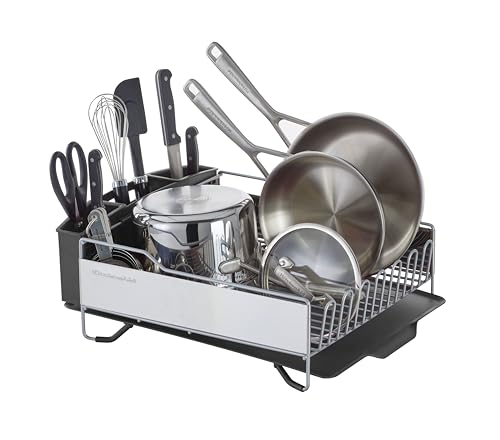
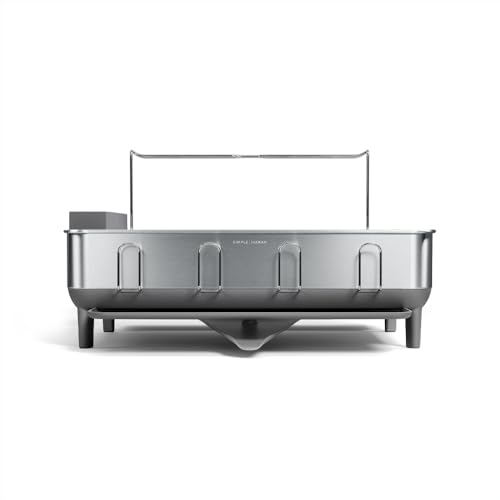

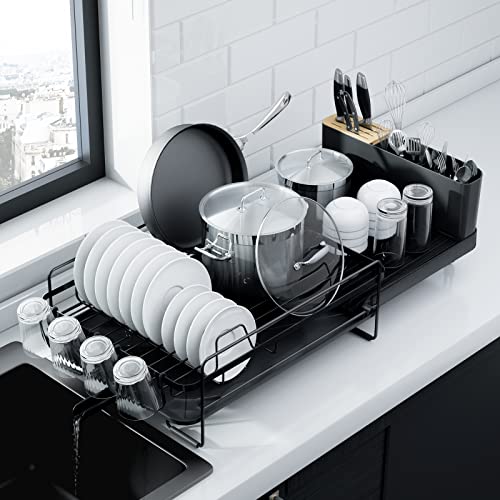
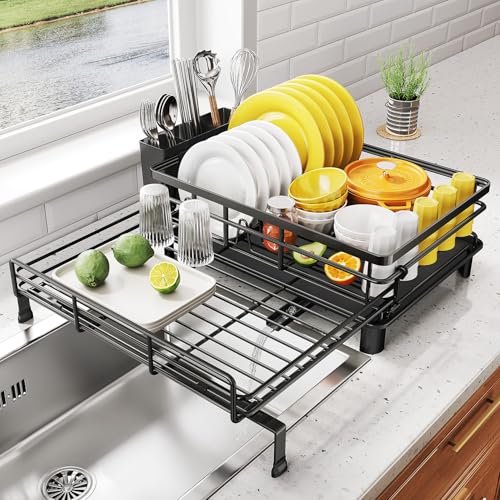


Who Should Buy Which Large Dish Drying Rack?
Families Who Cook Real Dinners Nightly
If your sink regularly holds a stockpot, a skillet, four place settings, and lunch containers, you are the core buyer for this size. Look for wide plate slots that accept thick stoneware, a utensil cup with dividers so cutlery dries instead of nesting wet, and a flat zone or board slot for the cutting board. Capacity claims should be judged by your worst load, the holiday dinner, not by an average Tuesday.
Households With No Dishwasher, or a Small One
When every dish is hand washed, or the dishwasher handles plates while pots and pans overflow to the counter, the rack becomes primary infrastructure. Drainage matters most for this group, because the rack runs wet all day: a sloped board with a spout that actually reaches the sink saves the counter from permanent puddles. Sturdy feet and a frame that does not flex under a full load of cast iron and stoneware separate a workhorse from a wobbly shelf.
Entertainers With Platters, Boards, and Stemware
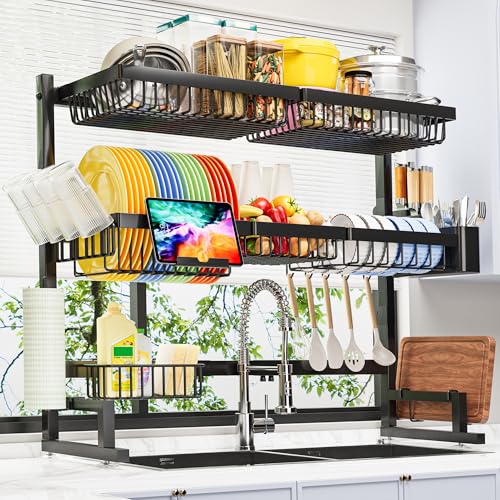
Hosts wash a different load: serving platters, wine glasses, big bowls, and boards that defeat ordinary racks. A two tier layout or an over sink section gives that awkward inventory a place to drain without colonizing the whole counter. Cup and glass holders along the side keep stemware off the main deck. If your kitchen is small but your gatherings are not, this is also the group that should seriously measure for an over the sink layout, covered in the sizing section below.
Key Features to Compare
Footprint and True Counter Fit
Large racks run roughly 17 to 24 inches long once the drain board is included, and that second number is the one listings bury. Measure your counter run between the sink edge and the wall or stove, then compare it against the full footprint with the board extended, not the rack alone. Height matters too if cabinets hang low: a two tier rack full of plates can reach up into the cabinet shadow. Leave a margin, because a rack that fits exactly leaves no room for the sponge, the soap, or your hands.
Two Tier vs Single Level Layouts
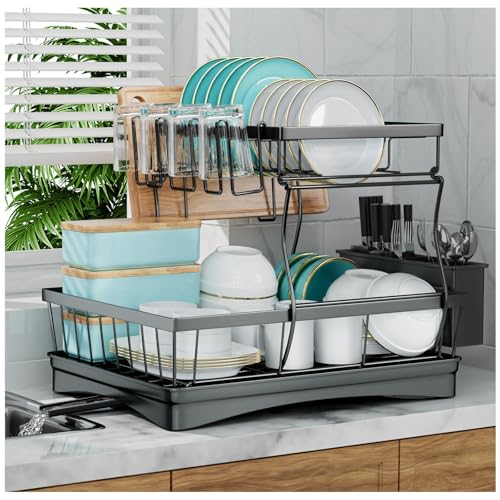
Two tier racks stack plates above and bowls or mugs below, multiplying capacity inside the same footprint, which is their whole appeal. The trade offs are height, stability, and dripping: the upper tier drains onto the lower one, so glassware below gets re wet. Single level racks spread the load out, dry everything with better airflow, and feel steadier under heavy pots, but they consume serious counter. Choose the tier if counter is your scarce resource, and the single level if stability under cast iron is.
Drainage: Slope, Spout, and Board Design
Drainage is where large racks earn or lose their keep, because more dishes means more water. A good design slopes the whole board toward a spout, and better models use a swivel spout that aims into the sink from different counter positions. Raised ribs keep plates out of the runoff. Beware flat boards with a decorative lip: they hold a shallow lake that breeds slime and mineral film. If your sink has a high rim or your rack must sit away from the edge, spout reach becomes the deciding spec.
Material and Rust Resistance
Stainless steel frames lead on durability, and the grade matters: higher grades resist rust in a permanently wet life far better than coated wire, whose coating eventually chips at the welds and rusts from the cut. Shoppers set on metal should compare the best stainless steel dish drying rack class for the rust resistant end of the market. Plastic racks avoid rust entirely but can stain and flex under heavy loads. Whichever you choose, rubber capped feet protect counters and stop the slow creep toward the sink edge.
Slots, Holders, and Utensil Storage
Details decide daily happiness. Plate slots should be spaced for thick modern stoneware, not thin diner plates, and at least one wide slot or a dedicated groove should take a cutting board upright. A utensil cup with drainage holes and dividers keeps knives and forks from nesting into a wet bundle, and removable cups wash properly instead of growing a science project. Side cup holders free the main deck, and a knife block insert, where offered, keeps sharp edges off the drying pile and away from reaching fingers.
Measuring Your Counter for a Large Rack
Start with the tape, not the listing. Measure the counter depth from backsplash to edge, the run length available beside the sink, and the clearance under upper cabinets. Then decide placement: beside the sink with a spout draining in, or spanning the sink itself. If the counter run is too short, an over the sink layout from our guide to the best over the sink dish drying rack turns the sink basin into the footprint, freeing the counter entirely and draining straight down, though it asks you to wash around it.
At the other extreme, a true small kitchen may do better with the compact in basin approach of the best in sink dish drying rack style, which sacrifices capacity for zero counter cost. Most family kitchens land in the middle: a beside the sink large rack with honest drainage. Whichever layout you choose, walk the path you will carry wet pots along, because a rack placed a dripping journey from the sink guarantees a wet floor and a daily annoyance.
Common Mistakes to Avoid
- Buying by the rack dimensions alone and forgetting the drain board, so the setup overhangs the counter edge.
- Choosing a flat drain board that pools water, then blaming the rack for the slime and mineral film that follows.
- Loading a two tier rack top heavy with pots, which makes the whole frame tippy when a plate is pulled out.
- Picking coated wire for a hand wash everything household, where daily soaking chips the coating and rust follows fast.
- Skipping a cutting board slot, so the board keeps drying flat on the counter and warping against a puddle.
- Placing the rack where its spout misses the sink, quietly soaking the counter seam and the cabinet below.
How to Make Your Large Dish Drying Rack Last Longer
A drying rack lives wet, so its care is about water and minerals. Empty and wipe the drain board every few days rather than letting a film build, and descale monthly with a vinegar soak if your water is hard; vinegar is an acid, so use it on its own, rinse well, and never mix it with bleach or other cleaners. Pull the utensil cup and wash it in hot soapy water weekly, since it is the grimiest part of the system. Check the feet caps and spout joint now and then, dry the rack fully when the house empties for a trip, and store spare boards out of the rack so air can reach every surface.
FAQ
What size dish drying rack do I need?
Match the rack to your biggest routine load and your measured counter space, in that order. A household washing pots, pans, boards, and four or more place settings nightly needs the large class, roughly 17 inches or more of rack length plus the drain board. Measure with the board included, confirm the spout reaches your sink, and check cabinet clearance if you want two tiers. A rack slightly smaller than your worst load beats one that swallows the whole counter.
Can a large dish drying rack hold pots and cutting boards?
Yes, if it is designed for them rather than just scaled up. Look for a flat reinforced zone or wide end slot for boards, plate slots spaced for heavy stoneware, and a frame rated stiff enough that a full stockpot does not bow the deck. Many large racks hold a board upright along the back rail, which also keeps it off the wet counter. If your board is oversized, check its dimensions against the slot width before buying.
Is a two tier dish drying rack better than a single level rack?
It is better for capacity per inch of counter and worse for stability and airflow. Two tiers suit plate and bowl heavy households short on counter, while single level racks suit pot heavy cooking and anyone who hates a wobble. The upper tier also drips onto the lower, so plan what lives below: mugs and bowls shrug that off, while glasses come out spotted. Pick by your load shape, not by which photograph looks tidier.
How do you stop a large dish drying rack from rusting?
Start with material: stainless steel in a rust resistant grade or a fully plastic frame outlasts coated wire in daily wet service. Then manage water: drain the board, wipe it during the weekly kitchen clean, and descale mineral film before it traps moisture against the metal. If rust spots appear on steel, a paste of baking soda and water with a soft cloth usually lifts surface marks. Deep pitting means the finish has failed and replacement beats scrubbing.
How do you clean a dish drying rack?
Take it apart as far as it allows: cup out, board off, spout detached if it comes free. Wash every part in hot soapy water, scrub the board grooves and cup holes where slime collects, and soak mineral crusts with a vinegar solution before rinsing. Reassemble only when the parts are dry, so you are not sealing moisture into the joints. A monthly full clean keeps a large rack from becoming the dirtiest object in a clean kitchen.
Final Thoughts
The right large rack disappears into your routine: every pot has a place, water leaves on its own, and the counter stays dry. Measure honestly, demand real drainage, and choose a material that can live wet for years. Compare the layouts side by side in the product table above, and the best large dish drying rack for your kitchen will be the one still earning its counter space long after the newness wears off.


